Monday, January 19, 2015

Tree Work

This is the time of the year when we do all of our tree work.  In the December greens committee meeting we discussed our tree inventory on the course and decided to remove 10 trees that were either unhealthy or poor golf course trees.  That could be because they drop debris, have a shallow root structure that takes water and nutrients from the desired turf, or causing shade and/or irrigation problems because of their growth type and location.
Maple on #3 that is mostly wrotten and falling apart
Sweetgum tree dropping debris
Thorny gumballs from the tree - not ideal for a golf course
Blocking irrigation and sunlight, paired with shallow roots and being a pine leads no turf under the tree


We also limb up all the trees on the golf course.


After removal and limbing we then chip all the branches

Beginning tomorrow we will go out and grind all the stumps and sod the areas where the trees were.

Friday, January 16, 2015

Cartpath Work

One of our small projects for the winter is to clean-up some of the cartpath ends. Over many years of use and traffic, the end of the path starts to chip away, develop loose asphalt, and show extreme turf wear and compaction.  We do things on a regular basis to relief compaction and improve turf quality, but sometimes the asphalt needs work.  This causes the general traffic to avoid the straight off section of the path and use the two sides for exit.  Below is a picture from last summer, you can see due to the roughness at the end of the path everybody exits left or right.


By improving the asphalt and turf quality at the end of the path, ie a smoother ride and exit, we can get golfers to use more exit points.

As we have discussed in the past, the key with traffic on turf is scattering and moving the traffic around.  This improvement will now allow the golfer to also exit off the end of the cartpath along with the two sides.

Friday, January 9, 2015

Root pruning/grinding

One of our important winter tasks is cleaning up the shallow tree roots on the golf course.  Shallow rooting trees like cottonwoods are very un-desirable species because their shallow roots compete with the turf roots for water and nutrients.  Cottonwoods are the worst, because their roots as so shallow
they come through the surface and cause damage to mowers as they cross over.  Many of our irrigation wires and pipes are too shallow so we cannot use a plow to sever the roots, but instead we use a small stump grinder to cut and grind the roots at the surface.


Cottonwood trees can have roots that go 150-200 ft out from the tree.
Cottonwood tree in the background


After grinding down about 6 inches, we fill the scar with sand a sand / seed mixture just like a divot.

Thursday, January 8, 2015

Winter Conditions

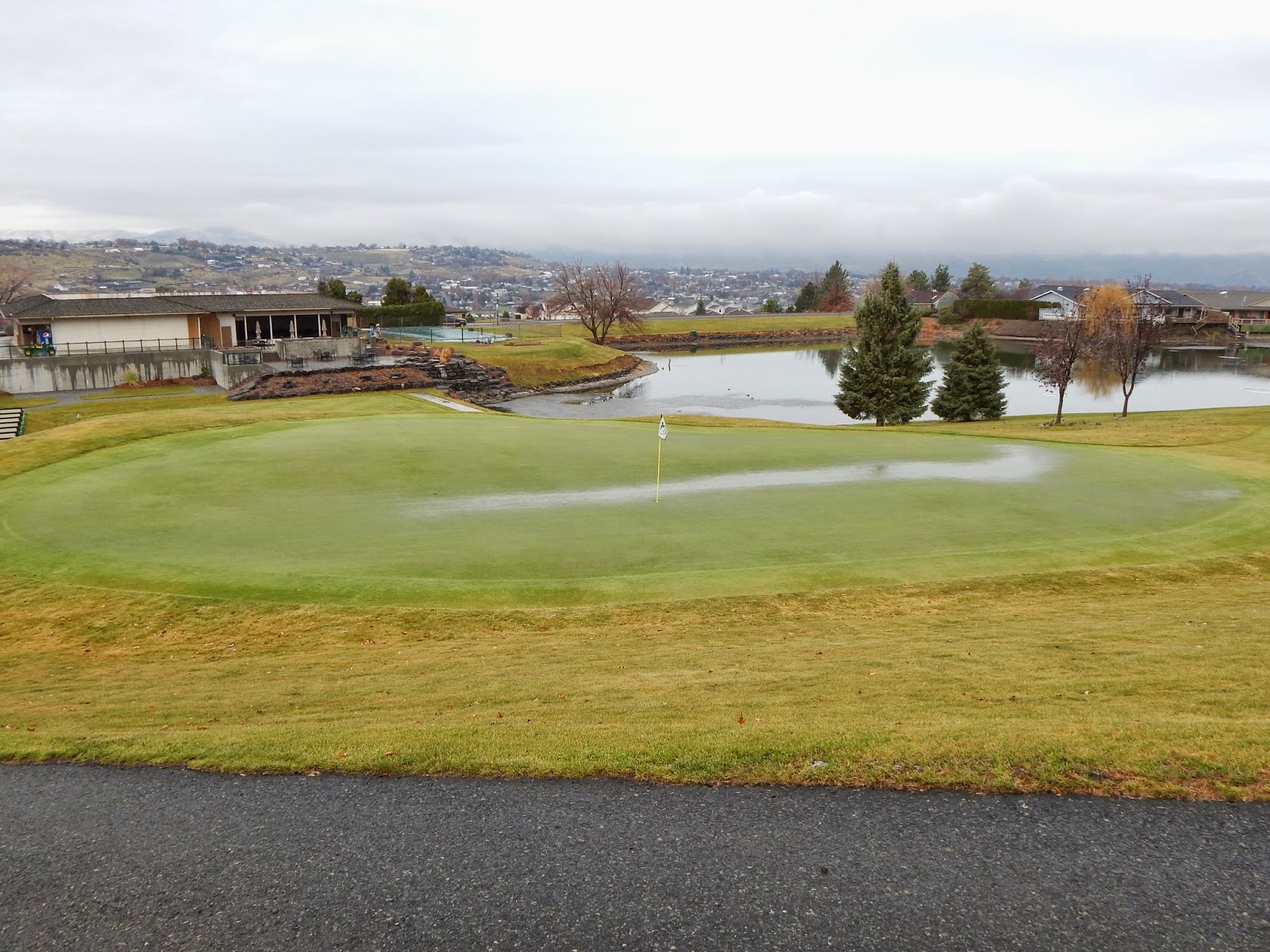
One of our challenging situations trying to keep a golf course open all winter in the north is the constant freeze/thaw and moist conditions.  We half frost delays over 50% of the mornings and several spells throughout the winter that do not get above freezing for a week.  This drives the frost in the ground any where from 2-5 inches.  We also have a wide variety of weather that changes on a regular basis, we get 3-6 inches of snow and then a couple days of rain, we also have great banana belt winter weather with many days in the 50's and sunny.  All of this paired together creates a lot of different elements and challenges trying to maintain a golf course in the winter.

Currently the golf course is quit soft because we had 2 weeks of cold weather that froze the ground, then 2 inches of snow, followed by a warm nightly breeze with lows of 48 overnight and rain that melted the snow.  When this happens we have all the free water sitting on top of the frozen ground that does not allow it to soak in.  


The water will help bring the frost out of the ground and allow infiltration.  It is always tough in situations like this when the weather has moved on and it is 45 and sunny but the course is still closed.  We have opened back up now for the last 2 days, the frost is out of the ground down to about 3" allowing the water to soak in that far, but that is what has created the soft conditions, the water is sitting on that frost layer in the ground.  Every week is different here in the winter, it might be frozen hard, it might be soft, or most of the time we have great winter golf.  

Friday, December 12, 2014

Winter Set-up

The blog has been a little slow recently and I apologize to my readers for that.  I have been focusing a lot of my time on being the interim GM while we search for a new one.  Overseeing the bar/restaurant and starting up the pro shop with inventory has been time consuming but a welcomed challenge.  The pro shop is now ready for our grand opening this evening as the club now owns the pro shop.


On the golf course, the agronomy team has been very busy the last month with leaf clean-up and setting the golf course up for winter play.  The toughest part about having a northern golf course open all year around is having traffic on dormant turf.  In the growing season the turf continues to re-grow itself and we play on a new surface everyday, but in the winter it is the same leaf tissue that continues to get the cart and foot traffic all winter.  

On tee surfaces, we combat this issue by using matts on the par 3 tees.

The remainder of the tees are set in 1 location and left in the same spot for the winter.  In the spring it is better to have one area of the tee box that is really beat up and needs to be seeded, compared to the entire tee having some damage.  This way in the spring we can use the 75% of the tee that is perfect, and just overseed that small portion that received the heavy traffic from winter.  On the greens, I set up 3 cups, the 1 we are playing today has the pin and the other 2 have black discs over them.  This way we can got out and change cups even when it is cold and frozen and still move the traffic around the green.


It has worked very good for us in the past and this year we set the golf course up for winter play the same way.


Friday, November 14, 2014

Fall Winterization

This has been a very busy week winterizing all aspects of the golf course.  The weather had to suddenly change on us making it less enjoyable, but always a good feeling to have things set for cold weather. Most of the week saw lows around 15 and hi's in the upper 20's forcing us to move along just in time.

We started with removing the fountains in the pond, prepping the on course bathrooms for winter, winterizing the waterfall at the clubhouse, and then the waterfall and pumps along #1. After that we spent 3 days winterizing the complete irrigation system, which involves pressurized air passing through all the pipes and heads on the compete course to ensure everything is free of water.  After that pumpstations and irrigation satellites were cleaned for winter, and now we are ready for some colder weather.  We also managed to get in some good labor hours on leaf clean-up this week.
1 of the compressors used
Lines being blow out through a drain - swans are just decoys to keep geese away, hence they don't move
Blowing out heads with irrigation satellites
Heads being blown out
Next will be prepping the turf for winter with snow mold chemicals, continued leaf clean-up, and course set-up for winter play.  Stay tuned as we move through those processes.

Tuesday, November 4, 2014

Leaves, Leaves, and Leaves

Leaf clean-up is in full swing.  As it has been a warmer fall, the leaf drop is about 2 weeks later than past falls.
Course was just cleared 1 day ago and they are back
Our process for staff has been chasing leaves everyday blowing off greens, blowing out bunkers, blowing off tees and approaches, and then gathering them all together from those areas, including fairways and rough, to be mulched up by the rough mower.  We use to pick them all up but we have went more toward mulching.  It is better agronomically, less labor and equipment use, and prevents them from returning to the course during the next wind storm.
But they are beautiful colors


Maybe with a little more winter activity like this we will have less labor in leaf clean-up every fall.