Showing posts with label trees. Show all posts

Friday, January 23, 2015

Grinding stumps

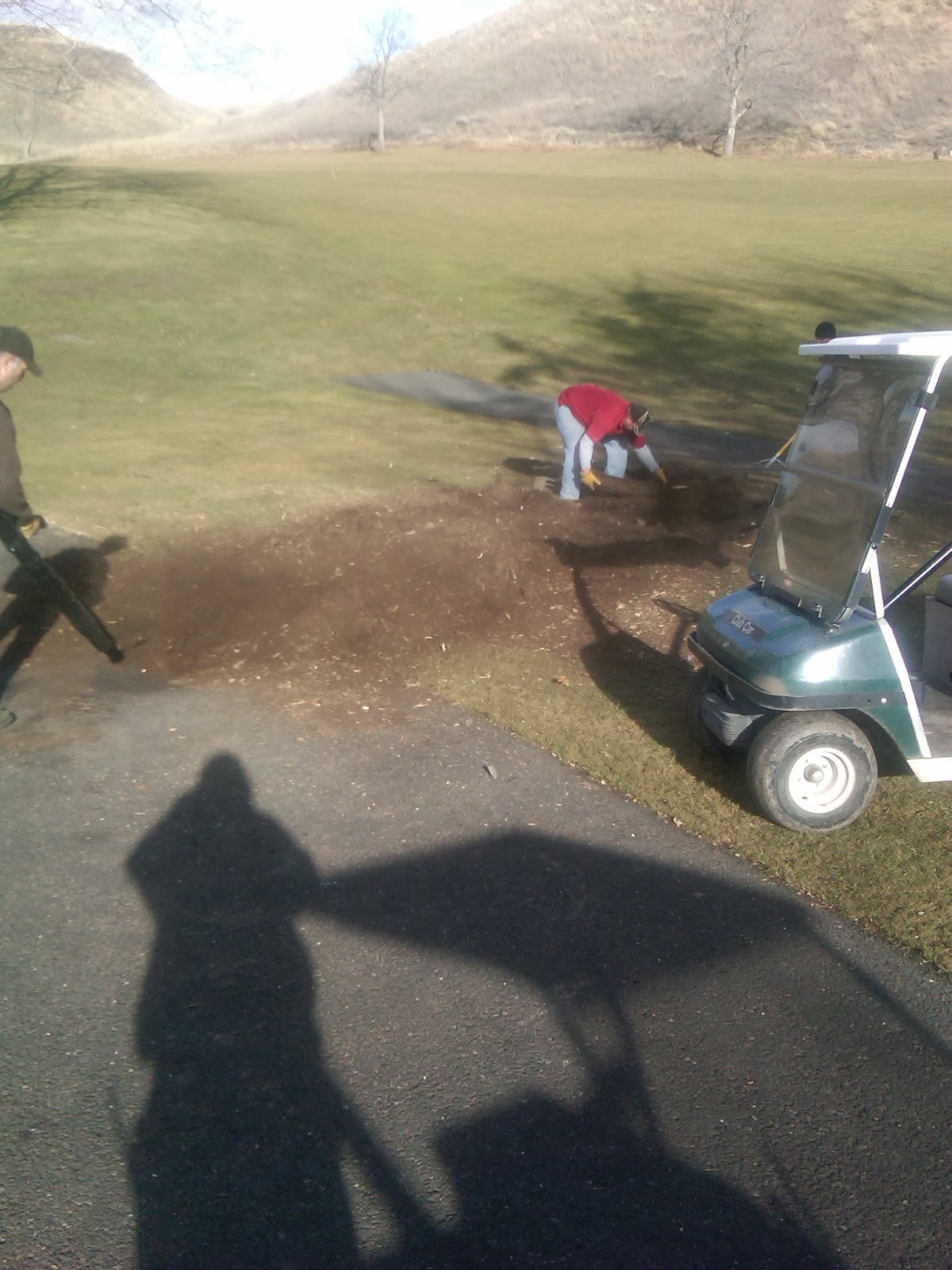
We have spent the last 3 days grinding all the stumps from the trees that were removed.


The idea with stump grinding is to get deep enough so you re-vegetate the area with turf.  So many grindings are just below the surface and then you can't grow proper roots and aerify for quality turf.  We grind the stumps in 2 phases.  The first cut is to remove most all the chips and are hauled away.  The second cut is a mixture of soil and removes the flare of the tree where it enters the ground, and any surface roots.  This cut is sifted clean and returned to the whole as a growing media.

The areas will be sodded next week.

Monday, January 19, 2015

Tree Work

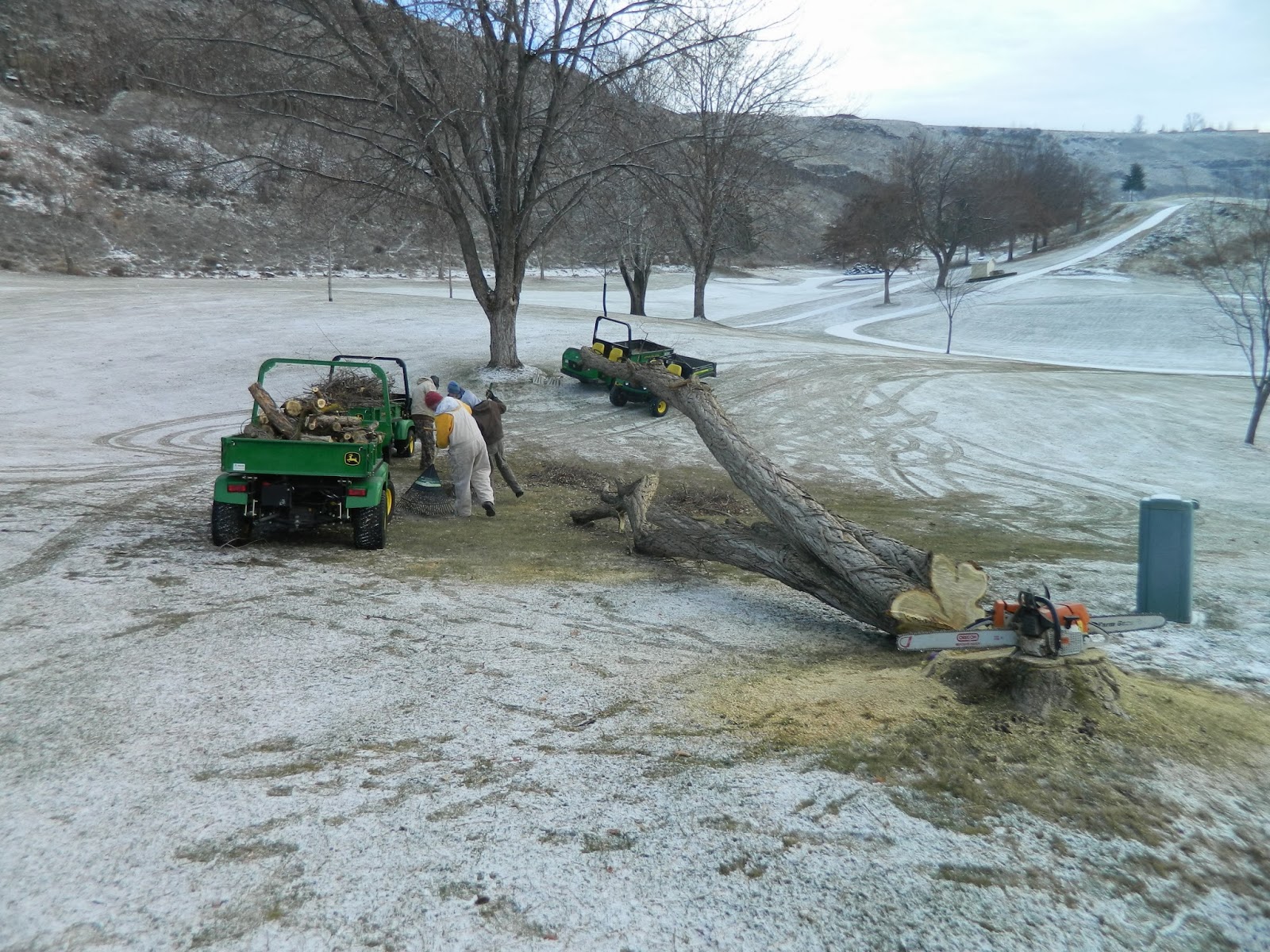
This is the time of the year when we do all of our tree work.  In the December greens committee meeting we discussed our tree inventory on the course and decided to remove 10 trees that were either unhealthy or poor golf course trees.  That could be because they drop debris, have a shallow root structure that takes water and nutrients from the desired turf, or causing shade and/or irrigation problems because of their growth type and location.
Maple on #3 that is mostly wrotten and falling apart
Sweetgum tree dropping debris
Thorny gumballs from the tree - not ideal for a golf course
Blocking irrigation and sunlight, paired with shallow roots and being a pine leads no turf under the tree


We also limb up all the trees on the golf course.


After removal and limbing we then chip all the branches

Beginning tomorrow we will go out and grind all the stumps and sod the areas where the trees were.

Friday, January 9, 2015

Root pruning/grinding

One of our important winter tasks is cleaning up the shallow tree roots on the golf course.  Shallow rooting trees like cottonwoods are very un-desirable species because their shallow roots compete with the turf roots for water and nutrients.  Cottonwoods are the worst, because their roots as so shallow
they come through the surface and cause damage to mowers as they cross over.  Many of our irrigation wires and pipes are too shallow so we cannot use a plow to sever the roots, but instead we use a small stump grinder to cut and grind the roots at the surface.


Cottonwood trees can have roots that go 150-200 ft out from the tree.
Cottonwood tree in the background


After grinding down about 6 inches, we fill the scar with sand a sand / seed mixture just like a divot.

Tuesday, November 4, 2014

Leaves, Leaves, and Leaves

Leaf clean-up is in full swing.  As it has been a warmer fall, the leaf drop is about 2 weeks later than past falls.
Course was just cleared 1 day ago and they are back
Our process for staff has been chasing leaves everyday blowing off greens, blowing out bunkers, blowing off tees and approaches, and then gathering them all together from those areas, including fairways and rough, to be mulched up by the rough mower.  We use to pick them all up but we have went more toward mulching.  It is better agronomically, less labor and equipment use, and prevents them from returning to the course during the next wind storm.
But they are beautiful colors


Maybe with a little more winter activity like this we will have less labor in leaf clean-up every fall.

Thursday, July 24, 2014

Summer Storm Clean-up

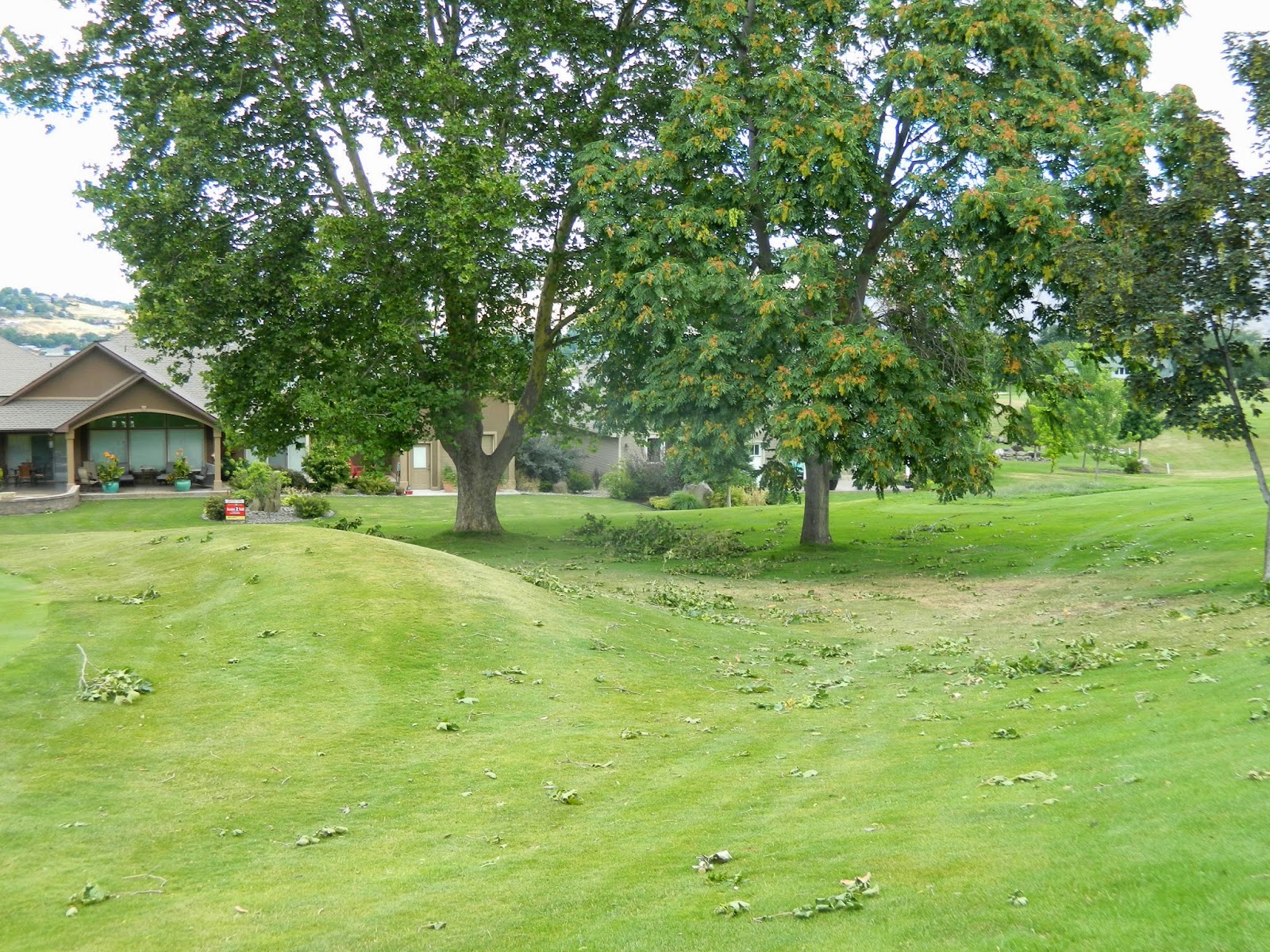
We had a storm roll through last night that was reported to have 60 mph wind gusts, heavy thunder and lightning, some areas saw hail, and minimal rain.  Just the type of storm that creates a lot of work for the agronomy team, winds to dry the golf course out, and very little rain that we can actually benefit from.  We lost 3 complete trees, nothing that was major or effecting play, lots of medium size branches, and a tremendous amount of small sticks and leaves.  Here are some pictures from clean-up today.


Blowing fairways clean of leaves
Most all of the big stuff was cleaned up this morning to allow ladies to play as normal, leaf and small sticks should be finished by the end of the day.

We did loose some of the tin off the roof of the cart sheds
We did not find any damage to the electrical portion of the irrigation system yet, but in the mist of all the clean-up, we did have an irrigation pipe break to repair today.


Saturday, March 1, 2014

Spring is coming

Even though it doesn't feel it today, there are some signs on the golf course that spring is coming.  This week we saw buds popping on the trees for the first time this spring.

Buds opening up on the tree
Up close of trees leafing out
These signs are telling us it won't be long now.

Thursday, January 9, 2014

Stump Grinding

Now that all of our tree removal is complete for the winter and Avista utility company has been through and completed all their work.  We went and ground all the stumps on the golf course.


Stump grinding is one thing I feel so many people or stump companies do not take it deep enough or don't take all the crown out surrounding the wood.  They grind just below the surface a couple inches, put soil over the top, and expect grass to grow next year.  Or they only grind the wood trunk portion and not the raised surrounding crown that is covered in soil and turf.


Here we grind about 1 1/2' ft deep and all the surrounding area that is raised up from the crown area.  Leaving us a perfect smooth and level area matching the surround, so after it is sodded it does not look like there was a tree removed there.

18" tree with a 5' stump grinding mark

Hauling away large debris and refilling the hole

Wednesday, January 8, 2014

Power Line Maintenance

The last 2 days the local power company, Avista, has been on the golf course removing and pruning trees that are encroaching onto the power lines and creating a safety hazard.


Just like roads and right-of-ways, power companies have a right-of-way directly underneath the power lines where they can remove or prune any vegetation that is growing, and there is a right-of-way that extends out 50' of the transmission line.  Some trees were limbed and 6 trees were removed.  They chipped the branches and we ground the stumps.

You see with the tree below, over the years the power company keeps trimming the top and we keep trimming up the bottom so we can play golf and get our maintenance equipment underneath.  Over the years it creates a very poor looking specimen and removal is the best option, allowing us to re-plant a lower growing species that will not get as tall.

Or with this location on the right side of #9 fairway, the greens committee is currently discussing the idea of adding a couple fairway bunkers to the right side.

Most of the trees removed have very little impact on the playability of the course, except this one on #9 is the only critical one.


Monday, December 23, 2013

Grinding Tree Roots

Tree work continues... as for the last few days we have been grinding surface tree roots. 

Cottonwood trees - surface roots
So many species of trees are poor selections for a golf course due to their shallow roots and even in some cases portion of the tree roots emerge above the ground.  See one of my early posts where I discuss the impact of trees on the golf course - Tree work.

On certain species these roots extend out beyond the drip line of trees and cause issues with the playability of the golf course, along with our maintenance and mowing equipment.  We use a small stump/root grinder and grind off the surface on the roots and then seed divot mix into the ground area.

Small 6" grinder to grind roots
After several roots have been ground
What the roots look like in the fairway before grinding
Effects of sub-surface, but shallow, tree roots on surrounding turf quality


Wednesday, December 18, 2013

Tree Work Update

The maintenance staff at Lewiston Golf and Country has been taking advantage of the snowy weather and frozen ground to work on various types of tree work for the last 3 weeks.  We spend about a month over the winter limbing up and pruning all trees on the golf course, pruning all landscape material and beds, and removing trees for various reasons.  The tree removal usually draws the most attention and is what I will focus on here.

Every year the greens committee takes 1 of our meetings to tour the golf course, discuss our tree inventory, and make a plan for the removal and planting process for the winter.  Tree are selected for removal typically based off of 4 things.

1)  Impact on irrigation coverage - trees inhibit proper distribution of our irrigation system and form "shadows" where the irrigation water is prohibited from going.  Our poor coverage of our older system magnifies this and trees creates a greater impact on our irrigation coverage.
2)  Sunlight and Air movement - they prevent turf from receiving the proper sunlight and air movement
3)  Increase cost of course maintenance - surprisingly they drastically increase our expenses to maintain the golf course when you consider the added time of rough mowers going around them, maintaining the grass adjacent to the tree edge i.e. weed trimming, clean-up from any debris the tree drops, leaf clean-up, and proper pruning and maintenance of the tree.
4)  Competition with grass - Even more so this time of the year, you can see the competition and how the trees take water and nutrients from the turf.  Follow a tree out to its drip line, that is approximately where the root system extends too, and within that drip line (circle) you will drastically see weaker turf.


My goal is not to remove all the trees on the course, but remove the ones that we can that effect our turf and playing conditions the most, while effecting playability and character of the golf course the least.


Also, when most trees are planted on the course, there is little attention paid to placement with respect to morning sun, which is the most important issue when dealing with turf management especially around greens and tees. This lack of attention is also the problem that when these trees are planted, they do not plan for the fact that trees grow and because of that the problems are amplified when proper location is not taken.  Lastly, is the choice of species.  Invariably whenever we have planted improper species and by this I mean an off site species (don't belong in this location and at this elevation).  This would be the case with the pin oaks which we have to treat every year with iron and zinc and will still lose some.  Then secondly quite often  when we start a course we purchase the cheapest trees.  This is the case of locusts, spruces and cottonwoods.   They are not wanted for domestic use much anymore and the nurseries are just trying to get rid of them.  The result is trees with shallow root systems, improper growth, weak structures and sometimes very serious clean up every year. 

OK, enough about tree education on golf courses lets get back to how we improved your golf course.

The trees that have been removed are the locust on the left side of #9 at 200 yds and the locust on the right side of #17 at 225 yds.  Those locust have a very shallow root system and steal water and nutrients from the grass making them a poor golf course tree.  Both of those trees had replacements planted several years ago right next to them that are now big enough to act on there own.  On #13 we removed the douglas fir on the right side at about 150 yds, here there were 3 in a row and by removing the middle one we really improved the turf quality without effecting the playability because the other two right next to it will prevent any shots from cutting the corner.  We also removed a coupe large branches from the cottonwood on #17 because we have planted small replacements right next to them and this will allow those smaller trees to grow up.  Due to the shallow roots that effect playability and our mowing equipment we have to start a plan to remove the cottonwoods in the future, and allowing replacement trees to grow for the next 3-5 years is the first step in that plan. 

On #2 green we had discussed removing some from the right side to get that green to play more consistent with the rest of the course.   The green is always firmer and faster in the summer because of less sunlight, and harder and more frozen in the winter.  We cut down 4 and left 3, and I know this will be a big in consistent playability compared to the other 17 greens.  Lets take a look. 
Before #2


After #2

The one tree that will develop some discussion because it was important for playability is the one on the right side of #2 at about 135 yards, I didn't want to remove this one but it was dieing and the inside was rotten.  We lost about half of the top of that tree in Aug this summer, and I am going to get a replacement planted there as soon as we can dig a hole.
You can see the entire middle section blew down this summer and the tree was rotten

The spruce tree on the back of 3 tee was also removed for similar reasons above.

It is a good location and distinguishes the corner of the tee separating 2 green from 3 tee.  But it puts a tremendous amount of shade on the tee and blocks irrigation.  Remember how poor that turf is on the back half of the tee and behind the tee.  
Shade right where the turf quality is the poorest
These pines block 100% of the light and water from getting through and they make it very difficult to maintain good turf there.  I agree it is a good location for a tree but it is the wrong tree.  A smaller nice ornamental would give us better turf conditions.  The bottom line is by removing it we will improve the playability and conditioning of the course and a smaller tree will give us a similar character and feeling.
Poor turf quality due to lack of sunlight, irrigation, and competition with surround tree roots

Our point through all this work is not just to remove trees, but we want the best balance we can have with appropriate golf course trees that create good shot making, playability, visual aesthetics, and character to the course while still allowing us to produce the best turf conditions that we can.  I feel we are reaching that balance point, but we have a little ways to go by replacing the cottonwoods, some of the spruces, and a few locusts in the years to come with the appropriate tree.

Moving forward now we will try to get everything done as fast as possible.  We will chip the branches on Thursday of this week. 
Branches ready for chipping


and stumps will be ground the first week of January.   


The firewood is almost all cleaned up already, and I would say by next week all the wood will have been removed.   


Avista utility company will be coming through the golf course in 2 weeks to limb and remove a few trees that are directly under the power lines, in their right-of-way.  These limbs and stumps will also be ground and chipped at the same time


All of this diligent winter work is important to ensure that we produce healthy and properly shaped trees that allow us to have playable turfgrass underneath them come next season.


Also, I am very happy to say the golf course is back to being open, even though there are frozen conditions it is still playing very good.