Showing posts with label greens. Show all posts

Friday, September 19, 2014

Greens Recovery

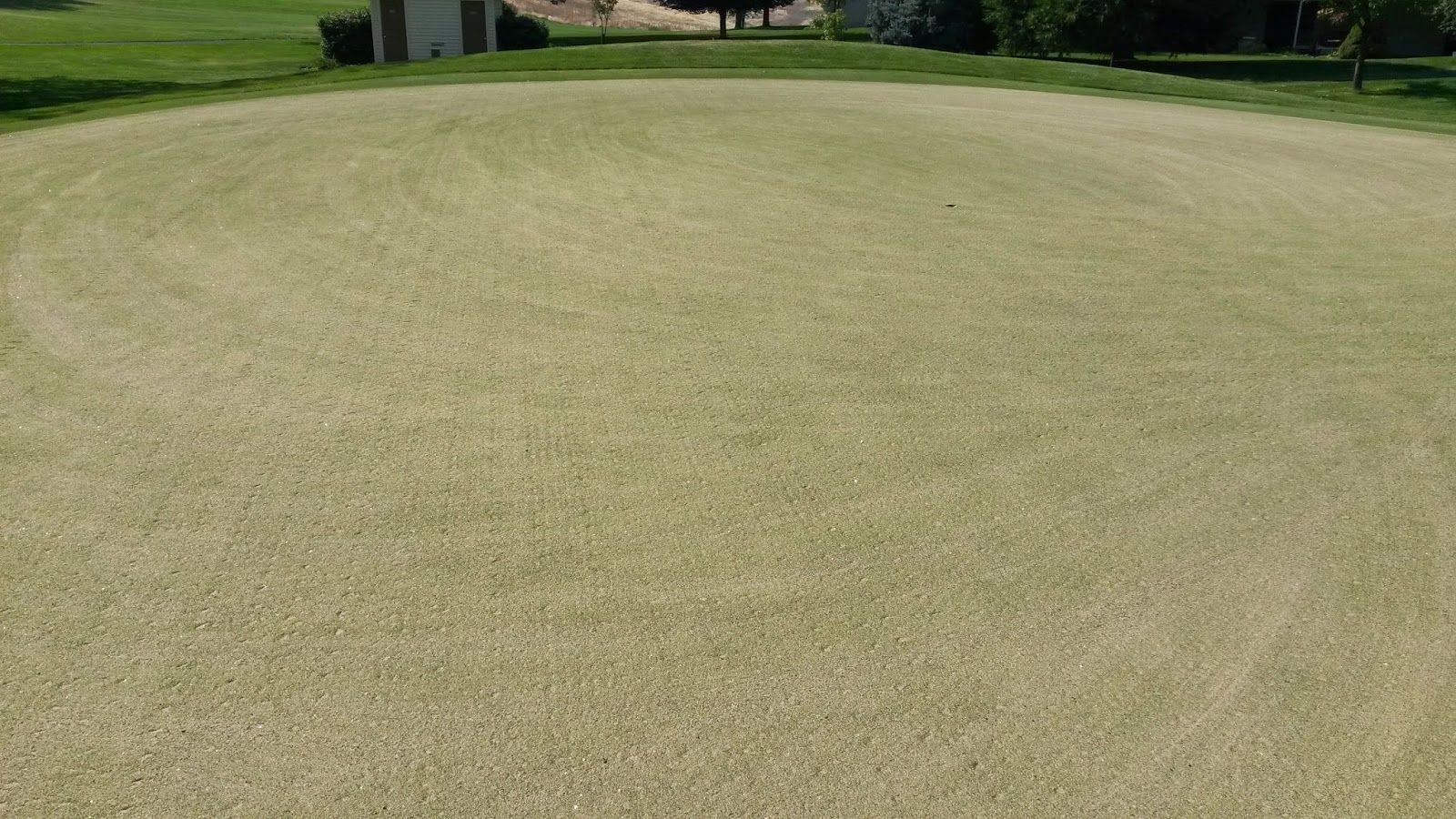
Greens are really recovering quickly from aerification.  They were fertilized prior to aerification so they were already actively growing before we punched them and timed with the sunny warmer weather we have received, they are very good for 3 days after aerification.

Rolling greens in the afternoon when it is dry and does not pull up sand
3 days after aerification, after the first mowing and another brushing

Thursday, September 18, 2014

Greens Aerification

Greens were aerified on Monday and Tuesday while the course was closed and the entire operation went very good.  Mother nature really helped us out with the sunny 90 degree weather.  One of the hardest parts is getting the sand to dry and properly fill the holes, with the ultra dry sand it worked very good this fall.  As I have stated before, there are many methods to aerification and you have to understand your end goal as to which operation you will perform.  This year our soil tests show that our organic matter content is very close to where we want it so we decided to not pull a core and go with both 1) deep tining - to increase infiltration, allow roots to grow deeper, and incorporate as much sand as far down as we could in he older sad profile of our USGA greens, 2) smaller solid tines at a very close spacing to incorporate as much sand as possible into the upper 3 inches of the organic matter layer.

Topdressing goes down first so the aerification machines vibration will help work it into the turf

Deep tining machine - 1" tines 8" deep with 4" spacing

After the deep tining

Followed by 1/2" sold tines with a 1 1/4" x 1 1/4" spacing

Double roll to smooth everything out

Finished with brushing and irrigation to water everything in.

The finished product after 2 days

Extra sand is still on the surface because I want to incorporate more into the turf canopy and some holes will open up as we continue to brush and water.  Right now all the holes look full, but some are bridged and have air pockets down in the hole.  As we continue to brush and water this sand will settle down and the extra sand will be brushed into the holes.

The future will be continued brush and irrigate, with a Thursday afternoon roll when it is dry and then start mowing Friday morning, followed by alternation of mow and roll for the next week.  Typically in 4-5 days I will have them pretty well cleaned up and putting smooth.

Thursday, August 28, 2014

Tournament time - Ball Roll

For our biggest and most competitive event of the season, ball roll and greens conditioning is the up most importance and a precedence we have set the last several years to have the greens rolling.  Using the term "ball roll" instead of greens speed for describing the quality of a putting surface, means the condition of a green is not just measured by the speed but also by how smooth, true, and consistent it rolls, and all of those characteristics in my opinion make up "ball roll".  Yes the greens will be very fast this weekend but they will also be ultra smooth, firm, true, and consistent.

2013 Whing Ding Sole Survivor
Staff has worked extremely hard the last two weeks fine tuning the condition of the greens.  Ball roll does not come from just dropping the height of cut, but it is a combination of fertilizer running out at the right time so the greens are very lean, the height of cut, sand topdressing for a smooth and firm surface, rolling frequency and timing, and the moisture level from irrigation in the green.  The first four items listed have all taken place over the last two weeks and now the only thing left is to dry the greens down as far as we can to get the hard firm surface.  A little strategic planning while we watch mother nature to get the timing just right so they peak with moisture level by Monday afternoon (the lack of), but we do not dry them down to quickly.  There are a lot of aspects that go into managing tournament greens and it is not just dropping the height of cut or turning off the water, but a combination of many different aspects.


Monday, July 21, 2014

Venting Greens

This morning is one of our opportunities when the maintenance staff is punching the small holes in greens, "venting".


We try to do this 3 times throughout the hot summer and it allows for oxygen to get down into the profile to the roots, and water to infiltrate through the surface better.  After a mow and roll, the holes are still visible but they do not effect the ball roll at all.

Thursday, June 26, 2014

Weighing Clippings

One thing that we do here at LGCC that I feel is very unique, is the staff weighs there grass clippings after they are done mowing greens each morning.  Every morning when the greens are walk mowed they dump their buckets into the back of their cart, after mowing there designated greens they empty their clippings at our dump site.  A couple years ago, I had the idea that since the clippings are all right there in their cart, why don't I put a bucket and shovel with a scale at the dump site, they could weigh their clippings each morning before dumping and report back a weight for each designated greens mowing route.
Our clippings weigh station at the dump site
Clippings in the back of a cart from the mornings greens mowing route, being shoveled into a 5 gallon bucket
Clippings being weighed
This information has turned out to be another very valuable tool that we use in managing our putting surfaces.  Surprisingly, the amount of dew in the morning or sand from topdresing does not effect the wight that much, a little increase is seen but not a big spike that throws our data off.  This information is another tool that truly lets me know what is happening with the greens.  We use moisture meters for water availability, we use stimpmeters for speed, we use firmness tools to check how firm the green is, and we all look into buckets every morning to see how much the green is growing and how much grass they are cutting.  This technique puts a true quantified number on the greens growth for the day before.  That information goes into a spreadsheet, and it is interesting to see the increase in growth after fertilizer and then the decrease that occurs over the next 14 days.

We fertilize our greens by spraying them every 14 days with liquid products, I do tweak that amount of fertilizer each application depending on time of year, disease pressure, upcoming events, and desired green speeds.  The amount of clippings helps me quantify how much fertilizer the plant needs that week and how much growth we are currently receiving.   It helps us achieve that consistency that I am always taking about throughout the growing season.

If you want to be as innovative as that "On Course" Colorado guy or impress your members as much as that plaid sport coat wearing comedian, try the idea of starting to weigh your grass clippings, you will be amazed by what information you learn from that.  Sorry LGCC members, an inside joke for my fellow superintendent readers in the turf world..

Wednesday, June 25, 2014

Turfscreen / Sunscreen

The greens are a little greener color right now because the first application of turfscreen went down yesterday.  Turfscreen is a relatively new product that was discovered by a superintendent who accidentally spilled sunscreen on a green.  Turfscreen acts just like sunscreen for the turf and it also has a green pigment in it that is beneficial to the putting greens turf.  You can see in the picture below that at the very bottom of the picture, the approach area, is more of our normal light green color, but then the straight line where the sprayer turned on has the darker green color on the putting surface.

Turfscreen protects the plant from the sunlight, lowers the surface temperature of the grass, and helps the turf from drying out and wilting as much.  Two years ago we did small applications to test the quality of the product and we were very impressed on how the turf was drying and wilting right next to the application, but the protected area had not wilted.  So last year we included it our regular fertilizer tank mix every two weeks.  From mid-June to the beginning of September, our greens will be protected with "sunscreen" and it is just another tool that we use to combat mother natures intense weather, and still produce the best putting conditions in the heat of the summer.


Tuesday, June 24, 2014

Needle - tining

With the temperature pushing 90 degrees it is that time of the year again, the greens were needle tined yesterday, very small solid needle like tines that punch a hole 4" deep.


This is performed during the summer months to do two things for our greens
1)  Gas exchange - as the greens turf continues to grow, carbon dioxide can start to build up in the profile, these needle tines open up the surface and allow the carbon dioxide to be released and clean oxygen to enter the profile to the roots
2)  Increase infiltration - allowing water to soak in deeper and be more available to the root system


Fortunately, unlike our spring and fall aerification, this is not disruptive to the putting surface.  Visibly you can see the holes but they do not effect the way the ball rolls.
The putting surface after the needle tines

Friday, June 6, 2014

Green speeds and growth regulators

If you have played in the past 2 weeks, you know the greens have been extremely quick, faster than our usual fast greens rolling 11-12 on the stimpmeter.

When it comes to green speeds there are many factors that are involved in creating a good green that is smooth and fast but still holds a shot.  Height of cut is the obvious one, water and moisture content, fertility level, mowing frequency, type of mower, rolling, and plant growth regulators.  We utilize all of these on a daily basis to create consistent fast greens.

Right now we are seeing the effect of multiple growth regulators on the green.  In the spring we apply 1 regulator to control the Poa Annua from developing a seedhead which would lead to bumpy greens.  In the summer we apply different growth regulators, some times a tank mix of 2, to keep the greens from growing too fast during the day and loosing our speed by the end of the day, along with many other agronomic benefits that the regulators provide.  This time of year there is always that transition from our spring regulator to our summer regulator, and we do not want to allow the greens to come out of regulation because then we will see a flush of growth.  To prevent this, we try to time it where the spring regulator is wearing off and the summer regulator is just starting.  Well right now we have both regulators having an effect on the greens and they are growing very little.  When staff mows greens in the morning they are collecting about 3 handfuls of clippings for every 6 greens mowed, next too nothing.  This is keeping the greens very consistent green to green and day to day, but it is making them faster than what we would normally desire.

Also, if you remember back to some of the blog posts last summer, Test plots, I am using a different regulator for the summer this year because I was not happy with the effects we had last year, so we performed several test plots of different types on the back edges of greens last year to see which one would give us the best effect.

Over the next couple weeks, the spring applied growth regulator will wear off and the greens will return to their normal speed, still fast, only having the new summer regulator on them.  For the mean time, stay below the hole.

Tuesday, May 13, 2014

Walkmowers on Greens

The walkmowers came out on greens today for the first time this season.  We use a ride on greens mower, called a triplex, through out the winter and the shoulder seasons of spring and fall.  Once the greens are cleaned up after spring aerification we start walk mowing the greens and do that until we aerify in the fall.

A triplex going across the green early spring - 3 reels contour independently, tires on the green, front and rear small rollers
The walkmowers provide a far superior putting surface after they are mowed compared to the ride on mower, but it takes 3-4 operators, mowers, carts, and fuel to do the job that 1 person and 1 machine can do the rest of the season.  That is why we only walk mow during our prime golf season.
 
Walk mowing #18
The walk mowers provide a better surface because of a multiple of reasons, 1)  there are no tire tracks going across the greens, 2)  the mower provides a better quality of cut the way it contours and rides across the green, 3) they provide less stress on the plant which opens it up for disease or more dehydration,  and 4) it is much easier and more effective to operate in tight places around bunkers and green surround.  The two most important benefits in my opinion are 1)  the walkmower rides on a rear drum that creates a rolling effect across the green leaving a smoother surface.  Similar to the dedicated roller that we use on greens, just not as heavy or effective, and 2) we utilize brushes on the mowers to stand the grass up before it is mowed and take the "grain" out of the green.
 
Once the tires are removed for mowing, the machine rolls on a large rear drum

Brushes on the mower that are put in the down position while mowing
Triplex mowers have come a long way in engineering and design the last few years but a walk mowed green is still superior to a green mowed with a triplex. 

Friday, April 18, 2014

Greens Aerification

This has been a busy week, starting off hosting the Frontier Collegiate Conference on Monday and Tuesday and then moving into greens aerification on Wednesday and Thursday.

This year with greens aerification we decided to make some changes.  When I first arrived here 4 years ago and sent away soil samples of our greens, they came back with 6.8% organic matter. Optimally you want to maintain your greens around 4% or slightly under.  This excess organic matter led to many problems, soft and spongy greens, shallow root system, disease pressure, and poorer putting conditions.
Core aerification last spring - lots of material
The organic layer held up all the nutrients and water, harboring disease, and led to scalping of mowers, soft conditions, and greens that were not smooth or fast.  We were very aggressive in core aerifying and pulling plugs both spring and fall the last several years.  This led to soil tests that came back at 3.8% organic matter in August of last year.  So this spring we used sold tines.  I always tell people that your type of aerification should be tailored toward your end goal.  Deep tine if you need infiltration or incorporating material deep into the profile, hallow tines if you are trying to remove organic matter, and solid tines if you want to incorporate sand into the upper profile.  Now with our organic matter where we want it, our goal was to put as many holes as we could in the upper 4 inches, incorporate sand, continue to firm up the upper surface, maintain smooth surfaces, and continue with organic matter breakdown.

By not pulling a core, we took a different approach and topdressed the greens first, then followed with the aerifier.  This allowed the vibration of the aerifier to help incorporate the sand into the profile and it really worked well.
Topdressing done (on right) then aerifying - quite the difference on what the aerifier is working in

Only the aerifier has gone over this, and 50% of the sand is already in the holes

Then the brush


Rolling them out smooth

Coco fiber matt to brush them smooth
Followed then by a heavy irrigation cycle, and continued brush, mow, and roll this week on an alternating schedule.  We should have them back in good shape in about a week.  


Thursday, April 10, 2014

Greens Aerification - Fertilization

Today we fertilized greens with a granular product.  Greens only get two granular applications a year, 1 in the spring and 1 in the fall, paired with the timing of aerification, and then just small amounts of various liquid products during the growing season.  This allows us to "spoon feed" the plant exactly what it needs and regulate our growth to a minimal level to maintain the green speeds that we want.
Fertilizing greens - 1 direction, overlapping half way with half the rate to achieve accuracy
One thing we do different than a lot of people is to fertilize the greens 5 days before aerification.  Our philosophy with this is that it takes 5-7 days for the product to dissolve into solution, be taken up by the plant, and to start growth.  By doing this now, the plant is actively growing the day we aerify and it considerably speeds up our recovery time after aerfication.  Many people aerify their greens and then fertilize right when they are done, I feel they loose a week of active growth by doing this and this is how we have been able to get our greens to recover so quickly after an intense aerification.

Yes, when we aerify we do remove about 15-18% of the green, organic matter, so we are removing that amount of our fertilizer, but I truly feel it is worth it when you consider a week of growth in the recovery process.  Greens aerification will be next week April 16 and 17, and the course will be closed for those two days.

Saturday, March 1, 2014

Bent / Poa Combination Greens

We are in the very early stages of the turf waking up.  Minimal visual green-up and no growth yet, but the plants are starting to wake up and starting metabolism.  You can tell that because our mixture of Creeping bentgrass and Poa Annua greens is just starting to become visible.

The bent is darker green and the poa is a lime green / grey color

Up close you can see what appears to be a hiegth difference between the two grasses 

 Spring is always when of the most difficult times to maintain smooth putting surfaces, because the bent will wake up faster and the poa will stay dormant, in a slumber and appear sunken, for a longer period during the cooler days of spring.  Once they are both out of dormancy and fully growing then this growth difference will diminish, but combination greens are a challenge early in the spring. To help offset this difference we will roll greens on a very frequent basis to maintain a smooth surface.

Friday, February 21, 2014

Greens Plugs

One thing we do over the winter to monitor how the turf is doing while dormant and frozen, is to take plugs out of the greens, bring them in the maintenance facility and plant them, and cover them to simulate a greenhouse effect.  This triggers the plant to come out of dormancy, and is a way for us to forecast what we should expect over the next month.

The planted plug with a simulated greenhouse

The plug up close

This is great to see and gives us a sense of relief once the soil starts to warm up and the turf comes out of dormancy.  It has been a colder winter, with more moisture and frozen conditions than in the past.  Coupled with the winter traffic that we put on the dormant turf and frozen soil, it is always a concern on how the turf is doing over the winter.

Things are looking good for 2014.