Wednesday, October 16, 2013

Tees - seed and turf selection

This time of year it is very interesting to look at our tee boxes because you can see the different types of grasses.  Our tees are predominately creeping bentgrass. On almost all green tees, the ones where we receive the most play, and in the areas of that tee where the green rocks are usually set we have a high population of Kentucky Bluegrass.
Bentgrass tee with bluegrass in the red circle, - the heavy play area of that tee

Here again - bluegrass in a bentgrass tee where the most divots occur
This is because at some point in the life of golf course, people used bluegrass seed in the divot mix.  That are of the tee gets the most play, it receives the most divots, and in turn the most seeding  - with a seed that is different than the grass type on the rest o the tee.

This is why when I first arrived and saw this, I changed the seed mixture and have later added the bottles to the tees.  It is also why I always explain to members and staff, only use that seed on tees, use that seed in fairways and rough, or don't switch your bottles with bottles on tees.  We want to keep the same turf types on each location of the golf course, meaning the same seed filling the divots, and keep that mono-culture look of the same stand of grass. We also overseed the tees with bentgrass during our aerification process.

Saturday, October 12, 2013

Fall is in the Air

The first leaves are starting to turn, and history tells us this is typically our first week of frost.  There are lows around 32 forecasted for the end of the week, so this might be the start of our frost delays, leaves changing, and turf slowing down.


Friday, October 11, 2013

Aerification complete

I am very happy to say that all aerification and topdressing is complete on the golf course.  We have a little detail work and clean-up in some areas, more brushing and working in of the sand, and a few misc areas to aerfiy like the nurseries and driving range tee.  But for the most part, the cultural practices are complete for the fall.  Thank you for your patience and here are some of the sights from the last 5 weeks.
  
Aerifying greens

Approach

Rolling greens

Our purpose

Picking up cores

Dragging fairway plugs

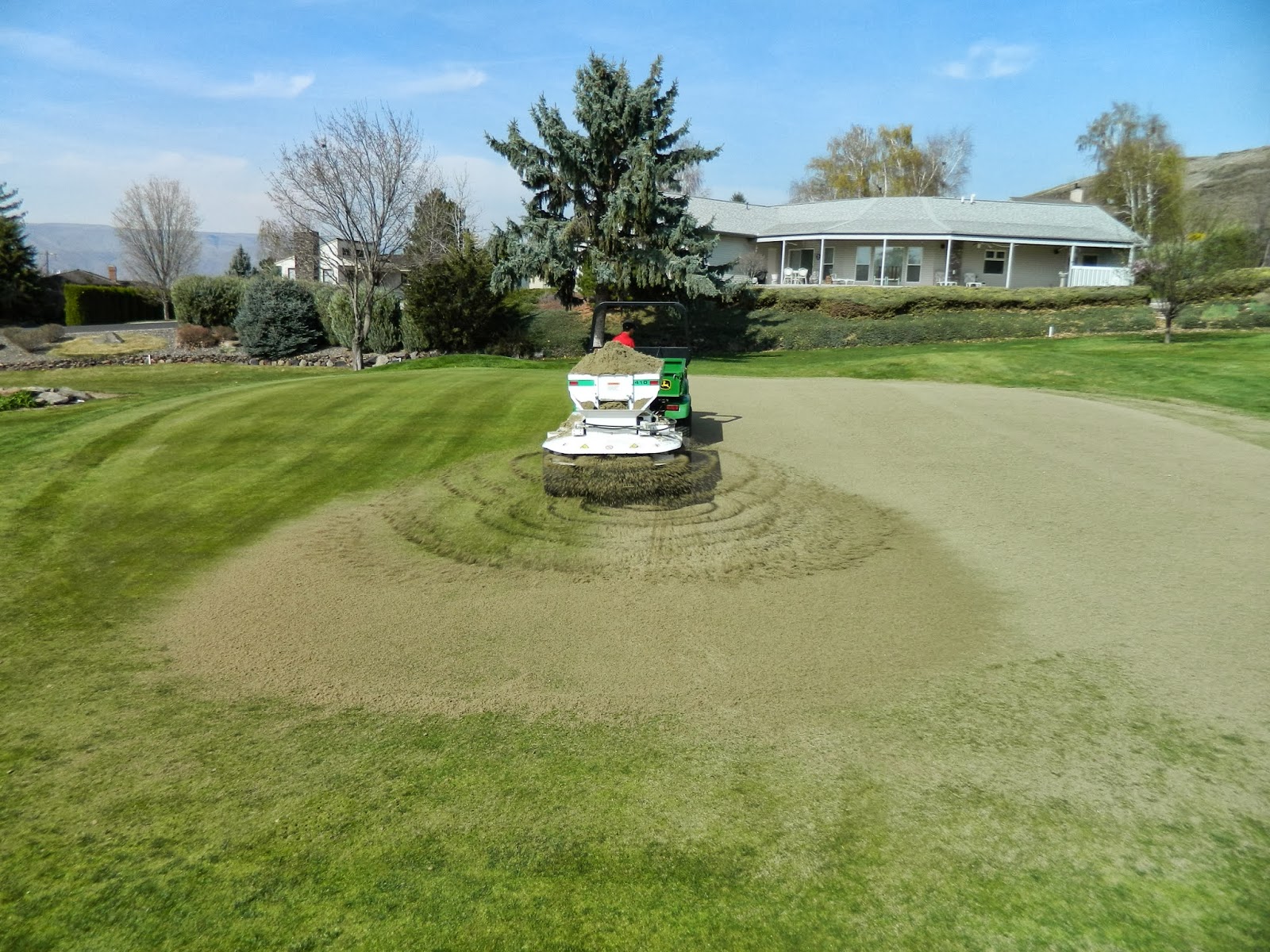
Topdressing greens

Fairway plaugs


Greens brushed in

Topdressing

Result after 5 days

Approach sand topdressing

Thursday, October 3, 2013

Tee changes

You may have noticed some tees have been scalped out, moved in, and re-aligned.  Over the years with continued mowing, different operators, and increasing or decreasing the edge of a tee box, they can start to take on a new shape and loose their alignment with the golf hole.

Re-alignment of some tees - the blue line is the new edge of the tee and alignment with the hole

Last week we went out and mowed the edges of the tees according to where they need to be for proper alignment, and also changed the shape on a few tees.  This was done in correspondence with aerifying tees so we could seed and topdress the area that need to be mowed out.

Wednesday, October 2, 2013

Test plots

As many of you know, one of my big philosophies is to improve the golf course every single year.  Every season we learn more about the course and try to implement better ways to get better results, and then those new ideas or "tests" that prove positive become part of our annual agronomic plan in the future.  Many of these improvements occur by choosing a few aspects to focus on each year and doing various test plots of different products, techniques, or cultural practices to see what will achieve the results we desire.

This season was no different, as many of you saw my usual blue paint lines and dots on the golf course through out the season. When any new chemical or product comes out on the market I will not use it on the entire course until I have done several different test areas with the product to assure it is going to re-act and respond the way it was advertised.  Our test plots are either to experiment with a new chemistry or try to do something different with an old technique.
Growth regulator test plot on the front of a tee box with various rates

This years test plots through out the course were:
               1)  Wetting agent test on greens
               2)  Soil amendments to increase infiltration
               3)  Different growth regulators on greens, tees, and approaches

Purpose:
              1)  Wetting agents increase the effectiveness of water in the soil, making water wetter, making water more available, improving the holding capacity of soil, improving water distribution, and decreasing localized dry spot. This year we tested 3 wetting agents, our 1 we have used and 2 new ones, applying each of the three to 6 different greens.
Wetting agent being applied


  2)  Toward the end of our summer season, our greens start to get "tired", all the hot weather, consecutive days of irrigation water that has "junk" in it, the tremendous amount of traffic from golfers and equipment, and the application of many products.  This leads our greens to start t seal off and not be as receptive to water, and allowing the water to soak down in. We applied 3 different products to 6 different greens each, then at the end of August we went and turned on the irrigation until the green had puddled up to standing water and recorded the time that took
Timing of an irrigation cycle to see how long before reaches this puddle stage

              3)  One aspect I want to improve on is the increase of bentgrass and the decrease of Poa Annua. This will be achieved with growth regulators that "hurt" poa and allow the bentgrass to overtake.  This year we applied 2 different growth regulators at 3 different rates on 3 different parts of the golf course (tees, approaches, and greens)
Growth regulator being applied

Effects of test plot - side view

You can see the three different rates and the different effects of each rate

Test plot in an appraoch - see the amount of bentgrass we have increased so far compared to the poa annua


Conclusion:
Through out the season we received some great results that will help us make decisions in the future on ways to better improve the golf course.

Tee and approach aerification

We are wrapping up aerifying and topdressing tees and approaches over the last week and half.  Below you can see some plugs from an approach and the amount of topdressing sand that we have built up on top of the native soil in just 2 years.  This sand layer on the surface allows the approaches to play better in so many aspects.  The sand increases drainage, increases firmness on the surface, smooths out the surface, allows us to mow at a lower height of cut, decreases disease pressure, decrease worm casts, and increases the overall health of the plant and playability of our approaches.   

Approach plugs

1 1/2" sand layer built up in 2 years


Tuesday, October 1, 2013

Greens recovery

The putting surfaces are recovering and filling in very nicely after that intense aerification.  14 days later and we have mowed the greens several times, rolled many times, raised the height of cut up right after aerification and now are in the process of lowering the height back down.

Up close on day 14 after aeration
Day 14

Back on day Day 1